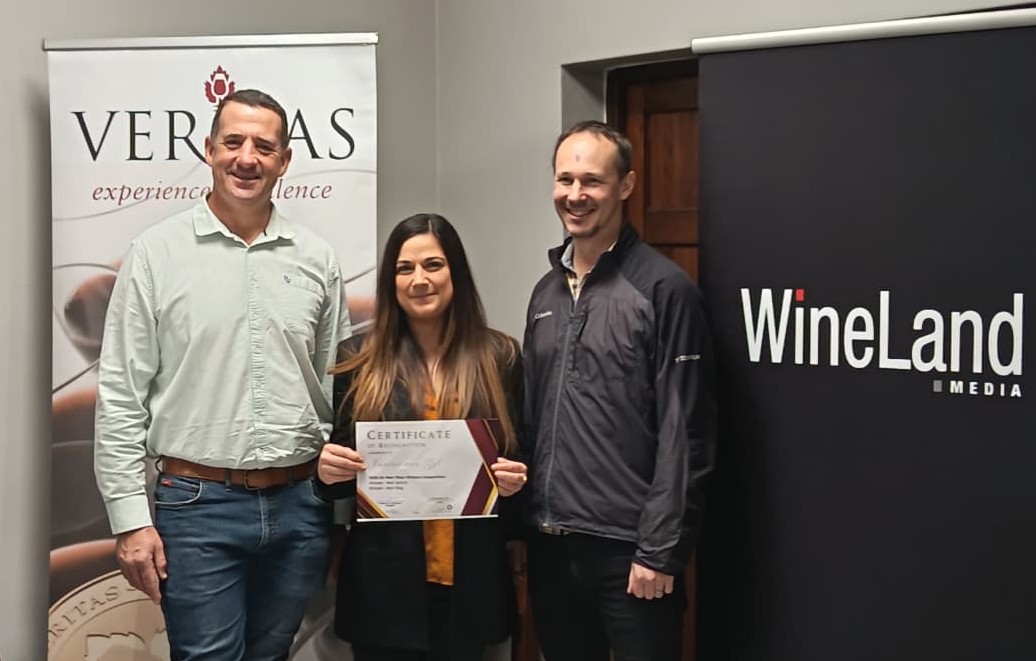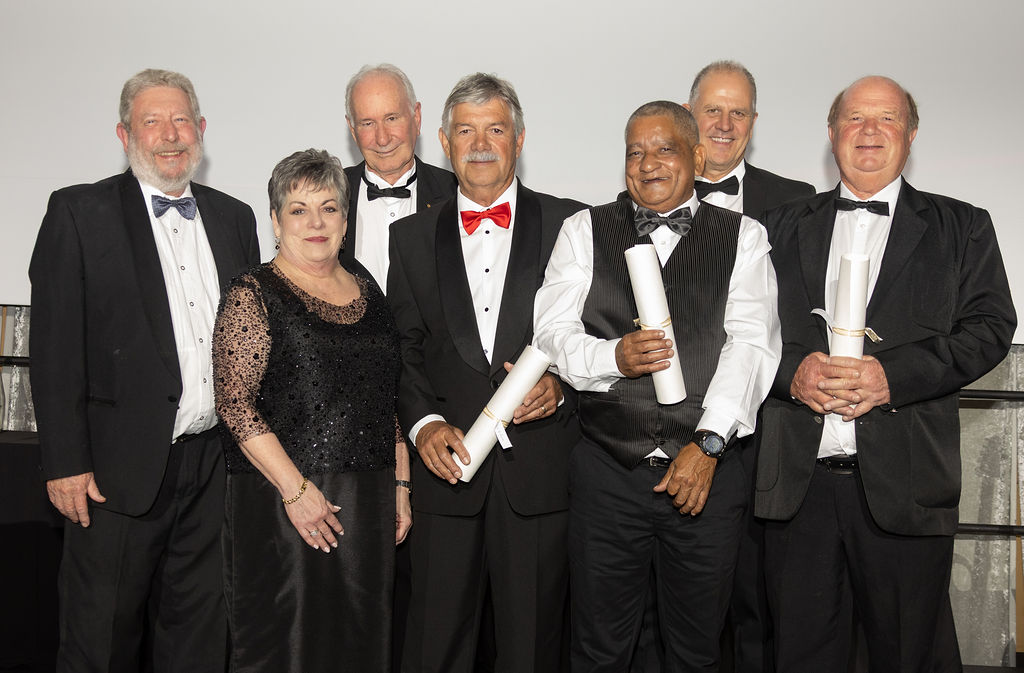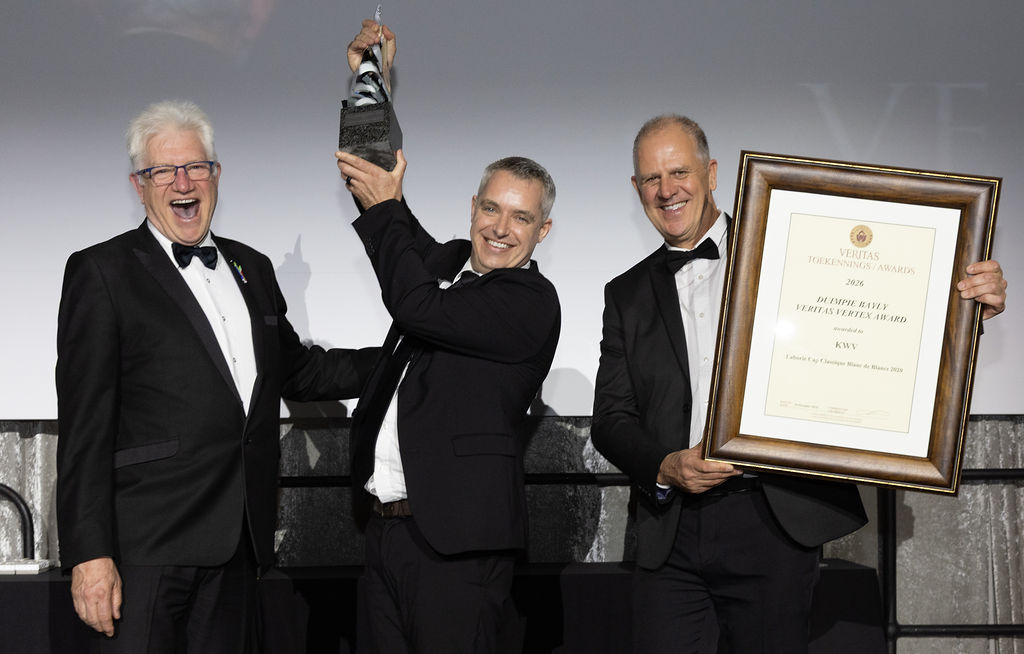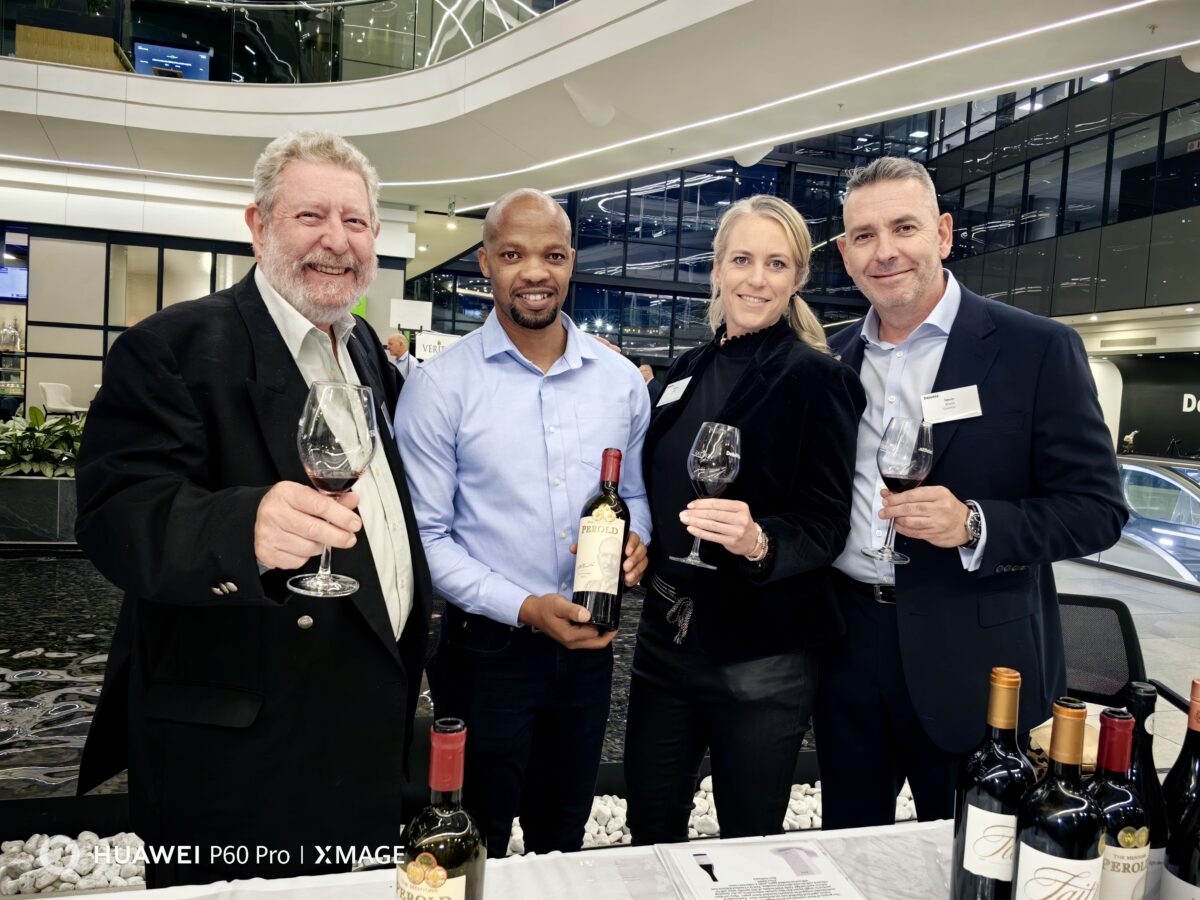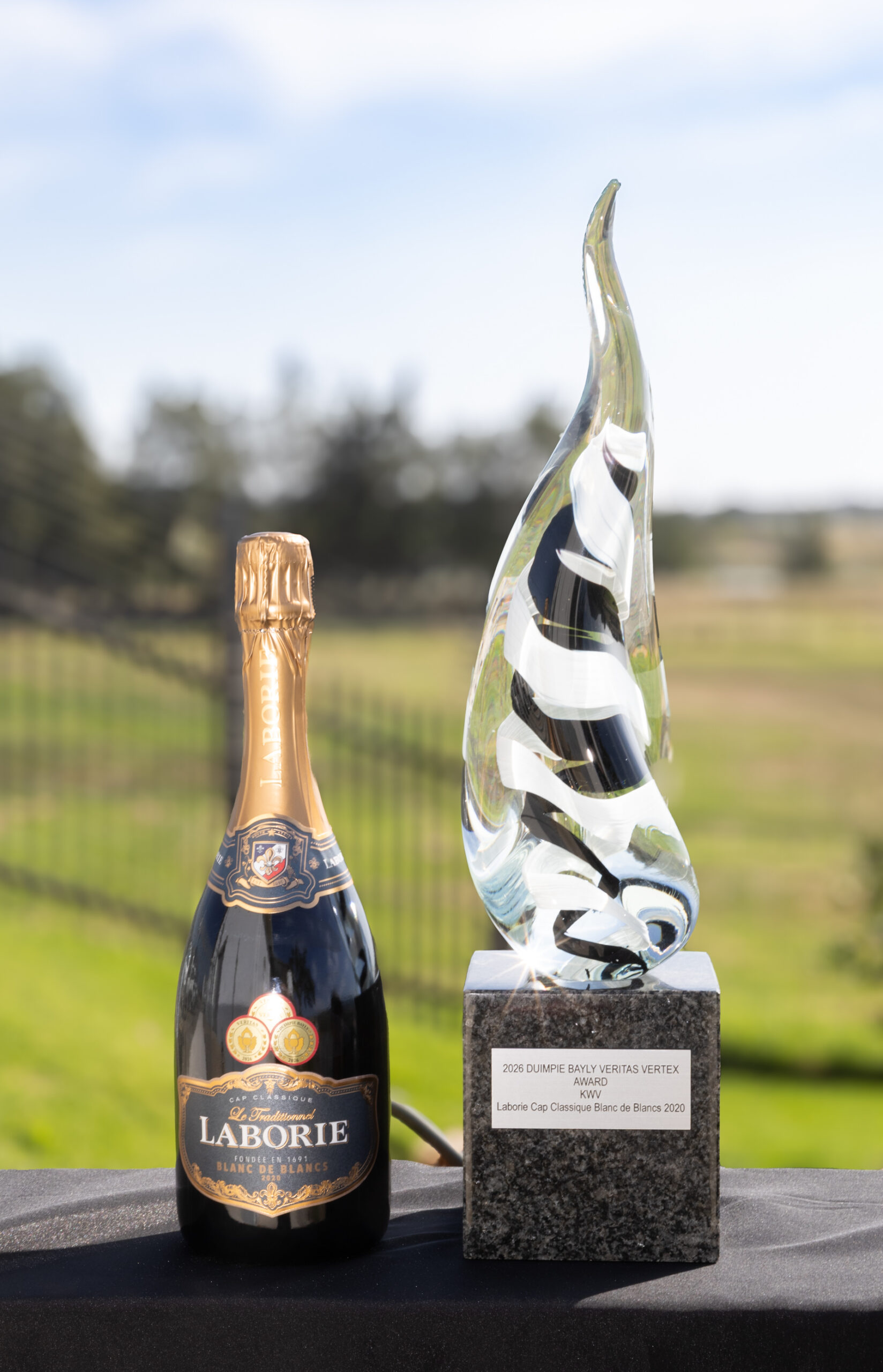

Left: The Veritas Duimpie Bayly Vertex Trophy and the winning wine the Laborie Blanc de Blancs Cap Classique 2020
Middle: Kobus Van der Merwe Senior Winemaker White Wines with the Veritas Duimpie Bayly Vertex Trophy
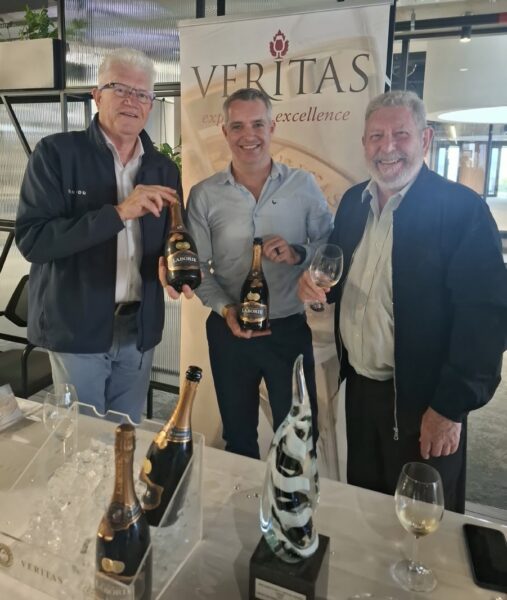
Right: Mr Alan Winde, Premier of the Western Cape, with winning Winemaker Kobus van der Merwe and Bennie Howard from Veritas at the Tasting of Double Gold and Gold winners at Deloitte Head office in Cape Town
The secret in creating the vibrancy and character of the victorious Duimpie Bayly Vertex Trophy with its Laborie Cap Classique Blanc de Blancs 2020 at the latest Veritas Awards, was patience, precision and intimate vineyard knowledge over time.
This, according to Kobus van der Merwe, KWV Senior Winemaker: White Wine, chatting after the company’s tour de force at this year’s Veritas Awards presentation.
For Kobus, this top South African wine accolade holds special significance and reward, as he has been positioned as “the face of Laborie” since joining the estate 13 years ago, although being the white winemaker and creating Cap Classique “only because it’s so synonymous with the KWV brand”.
As far as the brand is concerned KWV’s remarkable achievements at the South African wine’s illustrious “Oscars evening”, involved not only bagging the pinnacle Vertex Award for the fourth time in their history, but also securing 12 Double Gold and 12 Gold medals for wine and being named the Top Achiever for wineries entering 11 wines or more for the sixth time in seven years.
But the literally sparkling highlight of the extravaganza experienced by 580 guests in the CTICC Ballroom, was KWV ‘s receiving of the hand-crafted glass trophy as overall winner from a mammoth 1 293 entries – the third time ever for a Cap Classique. Five of the 14 wines in the Laborie portfolio are Cap Classique style, whose 2019 vintage Blanc de Blancs also clinched a double gold in the museum class this year.
Blanc de blancs literally means “white of white grapes” in French, and these Laborie traditional bottle-fermented style winners are produced purely from Chardonnay grapes actually derived from a single vineyard in Wellington.
KWV, of course, with a portfolio of no less than eight brands including the previous three times Vertex-winning Mentors – has access to source the finest quality grapes from 37 farms and 400 vineyard sites across the Western Cape. Its previous Vertex winners were the Mentors Orchestra 2018 (Bordeaux blend) in 2020, 2021 Mentors Perold (Cape Blend) in 2024 and 2022 Mentors Perold, 2025.
Kobus explains that the 30 hectares Laborie farm – situated on the slopes of Paarl Mountain close to the KWV head office and vast production premises – is largely focused on grapes for Cap Classique, mostly Chardonnay and Pinot Noir on the lower-lying sections. With production volumes exceeding the farm’s capacity, grapes are also sourced from other regions.
“Thereby we improve quality and complexity, with diversified flavour profiles and consistency in style.”
The magic “moving target” vineyard block
“This Wellington block is very diverse in slope, soils and trellising systems; so we harvest it at various stages, from different portions at various ripeness levels, not only guided by analyses but also walking through the vineyard and tasting before harvesting.
“We keep certain rows and sections separate, to use in only one type of barrel for fermentation, 15 to 20% new, and the rest used. Cold fermentation retains freshness and elegance, and we remove the wine from the full lees only after six to seven months before being on lean lees.”
“Blending various portions is the most important aspect here, as we often end up with up to eight different components from the single block. You must obviously have a strategy in place about the duration of aging and thereby determining the proportions, while predicting what the wine will look like in 24 – 36 months … even 60. It is a moving target. During aging, the wine is tasted and monitored all along.
Collaborative approach to a complex process
“My philosophy with the dosage is to do the minimum without changing the style, because the wine should have acquired its identity during ageing; it’s only to raise the sugar according to the market requirement, with three to six months in the bottle after dégorgement and once capped.”
“Great winemaking starts with understanding the vineyard. Winemakers are in the hands of Mother Nature and that every season brings its own opportunities and challenges. Success comes from respecting nature, understanding each vineyard site, and collaborating closely with the viticultural team to unlock the full potential of every block of vines. Through this collaborative approach, we strive to craft wines that authentically express their terroir while reflecting the artistry and skill of the winemaking process.
“I believe that winemaking is both a science and an art, requiring patience, precision and a willingness to learn from every vintage. The ever-changing nature of wine keeps one humble and honest, reminding that no two harvests are ever the same. Treat every grape with the utmost care and respect and allow the vineyard to tell its story through the wine.”
A passion for Cap Classique portrayed
The calm and down-to-earth Kobus, who lives in Paarl with his wife and two young daughters, hails from a grape farm in Montagu and studied Viticulture and Oenology at Elsenburg Agricultural Training Institute near Stellenbosch. He gained practical experience as a cellar hand at several leading wine farms across the Western Cape before completing harvests in Marlborough, New Zealand, and Sonoma, California.
Returning to South Africa, he was a winemaker at Opstal and Du Preez Estates in the Breedekloof wine region, refining his ability to produce quality wines at scale. It was during this time that he developed a particular passion for Cap Classique wines and the precision required to craft world-class sparkling wines.
In January 2013, he joined KWV as White Winemaker, where he today oversees the diverse white wine, rosé, and Cap Classique portfolio – ranging from premium offerings such as The Mentors to iconic brands including Cathedral Cellar, Roodeberg and Classic Collection. Here he works closely with KWV Cellarmaster Justin Corrans and the rest of the winemaking team.
“Cap Classique production is extremely difficult, with many steps requiring teamworking in total sync. This winning wine is an example of teamwork one hundred percent performed.
“The Laborie Blanc de Blancs 2020 shows perfect balance of secondary development flavours, depth, intensity and a yet tight palate, fresh, citrus, minerality, fine bubbles that help to carry the nose in the glass and on taste. Patience with the ageing process played a vital role to develop the identity and perfect balance.”
“The 2020 Blanc de Blancs was made during Covid, so there is something quite special about seeing something so beautiful emerge from such a challenging time. I am incredibly proud of this wine.”
The remarkable journey of Laborie Blanc de Blancs
The Veritas Vertex Trophy crowns an exceptional awards season for Laborie Blanc de Blancs 2020, which was named Best Wine on Show at the Amorim Cap Classique Challenge just weeks earlier. There, it also received the Trophy for Best Blanc de Blancs and Double Gold, marking the third occasion that Laborie’s Blanc de Blancs has secured the competition’s overall title, following victories in 2005 and 2023.
The 2020 vintage also earned 96 points and Gold at the 2026 Investec Trophy Wine Show, while Tim Atkin MW awarded it 92 points in his 2026 South Africa Report, naming it Best Value Sparkling Wine of the Year.
DESCRIPTION – 100% Chardonnay
This sophisticated Cap Classique exudes intense aromas of toasted brioche and roasted almonds with a smooth creaminess on the nose. The palate features creamy and voluminous textures balanced by citrus and zest. The fine and persistent mousse adds to the creamy textured mouthfeel, while the lively acidity brings vibrancy, culminating in a refined, lingering finish. The grapes were hand harvested into bins in the cool of the morning. They were then whole-bunch pressed and only the best cuvee juice was used for the final blend. A selected yeast strain was used for primary fermentation. No malolactic fermentation was permitted to ensure freshness. The wine was blended, bottled and underwent a secondary fermentation in the bottle. This was followed by bottle maturation of some 60months. Only then it was disgorged, corked and labelled.
Alcohol: 12.0% v/v pH: 3.00 Total acidity: 7.15 g/l Residual sugar: 5.87 g/l.
For more information:
tel 021 863 1599 or e-mail info@veritas.co.za
Social media
Facebook https://www.facebook.com/VeritasAwards
X https://x.com/veritasawards
Instagram: veritas_awards
Stay connected #VeritasAwards
www.veritas.co.za
Issued by Veritas Awards
Contact Bennie Howard, Marketing Manager, or Elsabé Ferreira, GM